

The FIFA World Cup isn’t just a big occasion for sports betting – it actually reshapes it completely. There is a global sports calendar event that happens only once every four years. In 2026, that event is bigger, longer, and more commercially powerful than at any other time in the history of the industry.
Affiliates should see this as more than a seasonal spike. This is a behavioral shift at scale and a completely different experience for all of us who want to make the most of it.
The Biggest Betting Window in Years (and the Numbers to Prove It)
The FIFA World Cup 2026 will take place from June 11 to July 19 over 16 venues in the United States, Canada, and Mexico. Moreover, it presents a new 48-team competition format, up from 32 in Qatar, resulting in 104 matches over 39 days.
It means 50% more countries, 40 more matches, and a host geography that drops fixtures right in prime-time viewing windows across North America, Europe, and Latin America at the same time.
The Financial Magnitude Is Insane
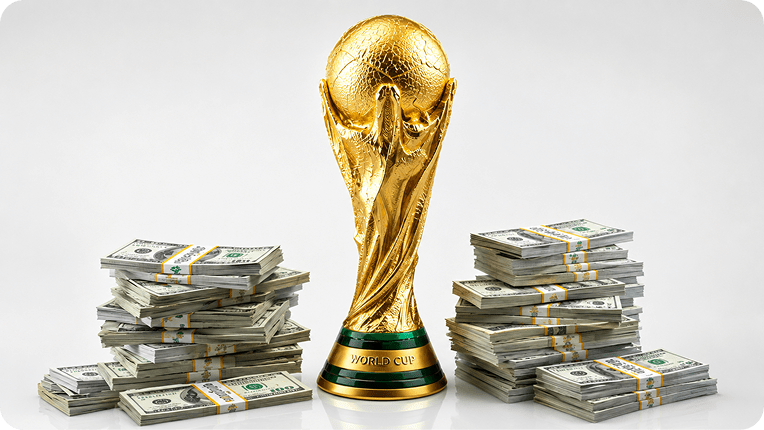
We are looking at a global betting turnover of over $150 billion, with revenue forecasts of $10.9 billion for the tournament – a 56% surge over the $7 billion generated in 2022.
In the U.S. alone, the analysts forecast somewhere between $3.1 billion and $3.6 billion legally wagered handle, more than doubling the $1.8 billion of the Qatar World Cup, thanks to the additional seven states with legal sports betting since Argentina lifted the trophy.
Brazil’s becoming a regulated market brings a new angle altogether: Betlaw experts figure that about 10% of the global World Cup betting volume will be in Brazil, roughly R$19 billion, making it the fifth-largest betting market in the world by revenue in its very first regulated year.
FIFA also expects that the total audience will surpass 6 billion people watching at least a part of the tournament, nearly 75% of the world population. Paysafe, which conducted a survey of 3,850 people across North and Latin America, discovered that 60% of them plan to place a wager on the 2026 World Cup, with 29% saying they would be making their first bet during the tournament only.
This is not just more traffic. It is a totally new type of traffic and those affiliates who understand this difference will be the ones who end up making money from it.
Why the World Cup Changes the Rules for Affiliates
Conventional affiliate marketing for sports betting promotes precision: the correct user, the suitable offer, the proper moment. It is a plan devised for a stable, relatively, pool of committed bettors — and it works perfectly for that scenario.
The World Cup turns the case upside down. When a top of the funnel expands to hundreds of millions of occasional and first-time bettors, narrow targeting is not just underperforming — it is leaving money on the table.
Reach Is King
Think about the structural things coming in 2026. Live betting is expected to take up about 55% of total World Cup handle. Those who bet in-play make decisions live, by the seat of their pants, quite often without operator loyalty. Therefore, this is not an environment for precision-targeting but rather one for visibility and reach.
Be On Time
Sportradar’s review of the last three major international football tournaments revealed that betting desire started to increase three to four weeks before the opening match, with new registrations and first-time deposits reaching their peak roughly two weeks before kickoff.
Affiliates who consider the World Cup only a June 11 event rather than a campaign that starts in May will miss the highest-value early acquisition window completely.
The playing field has shifted. It is no longer only about conversion. It is about attention grabbing early on, keeping one’s visibility on the entire span of the tournament, and being present when the intent turns into action.
From Precision to Scalable Reach: The Strategic Shift
Affiliates’ strategy during surge worlds must begin with a seemingly contradictory idea: wider reach, when implemented at a large scale, does not result in performance dilution during peak demand times, rather, it enhances it.
This is because under normal market conditions, wide net casting results in a large portion of unqualified users.
The cost of impression volume surpasses the earnings from the small percentage who do indeed convert.
However, when demand is surging uniformly across an audience the ratio changes. Having more impressions means having more entry points into a funnel where conversion intent is already boosted by the very nature of the event.
Smart Affiliates Will Earn a Lot From This
Consequently, affiliates who ramp up early enjoy benefits on two fronts. This is because during the pre-tournament phase, the competition for the viewer’s attention is low and the CPM/CPC costs are more attractive.
When the knockout rounds start and the competition becomes fiercer, those early campaigns have already created data, retargeting pools, and audience familiarity that performance-only latecomers are not able to match.
Nikolaus Beier, Senior Vice President of Marketing Services at Sportradar, suggests that operators and affiliates may want to go for a 50:50 division between performance and branding-related marketing expenditure initially and then optimize based on market maturity and competitive position.
The 70:20:10 model is broadly applicable across campaigns: most resources go to proven activities, 20% is set aside for experimentation with optimizations, and 10% is reserved for completely new approaches.

CPM and CPC as Strategic Advantages — Not Shortcuts
There is a widespread notion in the affiliate community that CPM and CPC types of remuneration are, in fact, quite low-commitment alternatives to CPA — perfect for creating brand awareness but not really for a serious performance-driven campaign. However, when viewed in the light of the World Cup, the whole context is drastically different.
In a situation of a demand surge, CPM and CPC provide the opportunity to capture demand even before it has taken its full shape. They facilitate a speedy launch and subsequent escalation to a pace that is impossible to match with CPA-only structures. Besides, they are very potent in three specific moments that characterize World Cup betting behavior:
- Pre-match (anticipation and research phase): Users look for information, odds comparison, and operator recommendations. Well-researched-oriented creatives perform very well in high-volume placements.
- During matches (impulse and emotion phase): The rise in live betting intention. Campaigns based on reach make sure that you will be present in the very moment when the decision is made, not just in the hours beforehand.
- Key fixtures (traffic spike phase): Matches with high public interest will lead to concentrated demand spikes that will be the source of generous rewards to those affiliates who are already familiar with their audience.
The change of perspective shouldn’t be thought of as “CPM/CPC instead of CPA”. It is more like, “CPM/CPC as a timing advantage that propels CPA performance afterwards”.
Dynamic bid optimization that is changing CPM bids while live moments are unfolding, switching from match-preview creatives to in-game content, without delay, this is the way sophisticated affiliates are viewing the in-play opportunity of 2026.
Where Reacheffect Fits In
When the World Cup surge hits, speed and reach matter more than anything.
It’s not just about finding converting users — it’s about reaching them first, at scale.
That’s exactly where Reacheffect comes in.
Scale instantly, not gradually
No slow ramp-up. No limited inventory.
→ Launch campaigns and expand fast across multiple GEOs as demand spikes.
Be visible when intent is forming
Most users haven’t chosen a platform yet.
→ CPM/CPC lets you get in front of them early, before the competition locks them in.
Match the pace of World Cup traffic
Traffic is emotional, unpredictable, and fast-moving.
→ Flexible models help you adapt in real time — before matches, during games, and around key moments.
Built for high-volume moments
This isn’t a normal campaign environment.
→ You need infrastructure that can handle spikes without slowing you down.
In short:
Reacheffect isn’t just about more traffic — it’s about scaling visibility exactly when it matters most.
Execution Framework for World Cup Affiliate Campaigns
So how do you turn the strategic reasoning into actual working processes? To answer this, we first need to be clear about what means of traffic, timing, and creative it will be like during a surge event.
Traffic Strategy
Focused targeting by cracking down on geographical areas for betting might not be the right approach in the early and group-stage phases of the competition. Instead of focusing on micromanagement of your target audience, put the emphasis on high-volume placement.
The World Cup of a 48-team format has brought about plenty of GEO opportunities which led to nations such as Morocco, Japan, Saudi Arabia, and Australia having their own loyal fan bases typical of passionate bettors, which are rarely targeted by mainstream affiliate campaigns.
Broadening your GEO targeting to include those national teams which qualify, especially in newly regulated markets such as Brazil, Peru, Chile, and Paraguay, opens you a channel of volume which CPA-focused campaigns typically neglect.
Resist splitting your audience so narrowly that you lose track of the big picture. Only after the initial stages of your campaign will it be possible to identify a segment ready to be used for focused communication. Start by building reach and let the funnel be your guide to narrowing the target audience later on.
Timing Strategy
| Phase | Timing | Audience State | Priority Tactic |
|---|---|---|---|
| Pre-Tournament | 3–4 weeks before June 11 | Anticipation, research | Brand visibility, broad reach |
| Group Stage | June 11 – ~July 3 | Engagement building | GEO-specific campaigns, data gathering |
| Round of 32 / 16 | Early knockout rounds | Intensity rising | Retargeting, offer-specific CTAs |
| Quarter & Semi-Finals | Peak tournament drama | High emotion, high intent | Live-match placements, urgency messaging |
| Final – July 19 | MetLife Stadium | Maximum global attention | Full-scale reach + retargeting convergence |
Creative Strategy
World Cup themed advertising strategies work best when they are able to connect with the emotional aspect of the event rather than simply relying on generic sports betting messages. Here are 3 different ways that typically yield higher results:
- National pride framing: Using “Back your team” as a bet makes it more of a gesture of loyalty rather than just a financial decision. It works well with first-time and casual bettors who are more interested in their identity rather than their strategy.
- Live-event urgency: In addition, ads focusing on a match, kickoff countdown, or game moment will create an element of time pressure in a natural way without scarcity being forced. The element of urgency at the event is quite self-explanatory.
- Simple direct calls to action: It is widely recognized that casual bettors would prefer things to be simple. In point of fact that clear CBAs, easy signup, and single-step CTAs have been shown to perform better than info-loaded ads in highly emotional environments.
Scaling Without Losing Control: The Data-First Approach
Scaling fast is necessary. However, scaling without any form of control can take a World Cup opportunity and turn it into a budget bleed. The secret lies in knowing when to make the funnel more exclusive and when to allow the campaigns to freely breathe.
During the initial stages of a surge environment, the campaigns require a large number of people in order to generate data that will have statistical significance.
Overly limiting targeting even before that data is present not only fails to guard the budget but actually makes learning impossible. The pragmatic approach:
- Start broadly and keep an eye on performance indicators like CTR, registration rate, early deposit signals without making the funnel more exclusive too quickly.
- Shed light on the different campaigns by device type (mobile vs. desktop) to be able to tell where the biggest differences in conversion rates are, a distinction that will be even more important as by 2026 over 55% of in-play handle will be done via mobile.
- Limit the number of times a user is shown the same advertisement once the phase of data-gathering is over in order to avoid spending more on a user who has already been exposed but has not converted.
- Create retargeting audiences from early-phase reach so that as competition gets tougher during the knockout rounds, you are re-engaging a warm audience rather than paying to reach cold traffic at peak-competition prices.
Who Wins the World Cup Surge: A Listicle
After 2022, after every major tournament, the pattern repeats. Some affiliates generate outsized returns. Others execute technically sound campaigns and still leave most of the value uncaptured. Here’s the clearest way to characterize the difference:
✅ Affiliates Who Win the World Cup Surge:
- Start before the tournament does. Sportradar’s data is unambiguous: betting intent rises 3–4 weeks before kickoff. Affiliates who build brand familiarity in May are not wasting spend — they’re reducing acquisition costs for June.
- Scale reach before tightening conversion. They understand that the funnel expands before it deepens, and they build impression volume accordingly before optimizing.
- Use CPM/CPC as a timing tool, not a fallback. They treat reach-based buying as a deliberate phase of campaign architecture, not a plan B.
- Expand GEO targeting to follow the 48 teams. They don’t just target the U.S., UK, and Western Europe — they build campaigns around Brazil, North Africa, East Asia, and other markets where national team passion drives betting intent.
- Build retargeting infrastructure from day one. Every impression in the group stage is an investment in a warmer audience for the knockout rounds.
- Create for the emotional context, not the product. “Back your team” outperforms “Get a signup bonus” in a national-pride-driven event. They know the difference.
- Stay visible through the full 39-day arc. They don’t front-load everything into the opening weekend and go dark. Sustained visibility across the tournament creates compounding returns.
❌ Affiliates Who Miss the World Cup Surge:
- Wait until June 11 to start campaigns, paying peak CPM to reach an already-saturated audience.
- Over-segment targeting from the outset, restricting reach before the data supports it.
- Rely exclusively on CPA models that can’t scale fast enough to capture the surge’s early and mid-phases.
- Run generic creative that competes on offer terms rather than emotional resonance.
- Treat the World Cup as a single event spike rather than a 39-day behavioral shift.
Conclusion: Capture the Surge. Don’t Chase It.
The 2026 FIFA World Cup doesn’t just increase betting demand, it temporarily transforms the entire market.
Casual fans become first-time bettors. National identity overrides brand loyalty. Live-match impulse replaces considered decision-making. And six billion people, concentrated into a 39-day window, create a level of sustained global attention that no other sporting event approaches.
The affiliates who capitalize on this moment won’t do it by spraying budget indiscriminately or by running the same narrow-targeting playbook they use the rest of the year. They’ll do it by understanding that surge environments reward reach, visibility, and early positioning — and by having the traffic infrastructure, model flexibility, and creative discipline to execute on that understanding.
Be everywhere that matters, when it matters most. The World Cup doesn’t wait for affiliates to get ready. The question is whether your strategy — and your traffic — is built to move at tournament speed.