

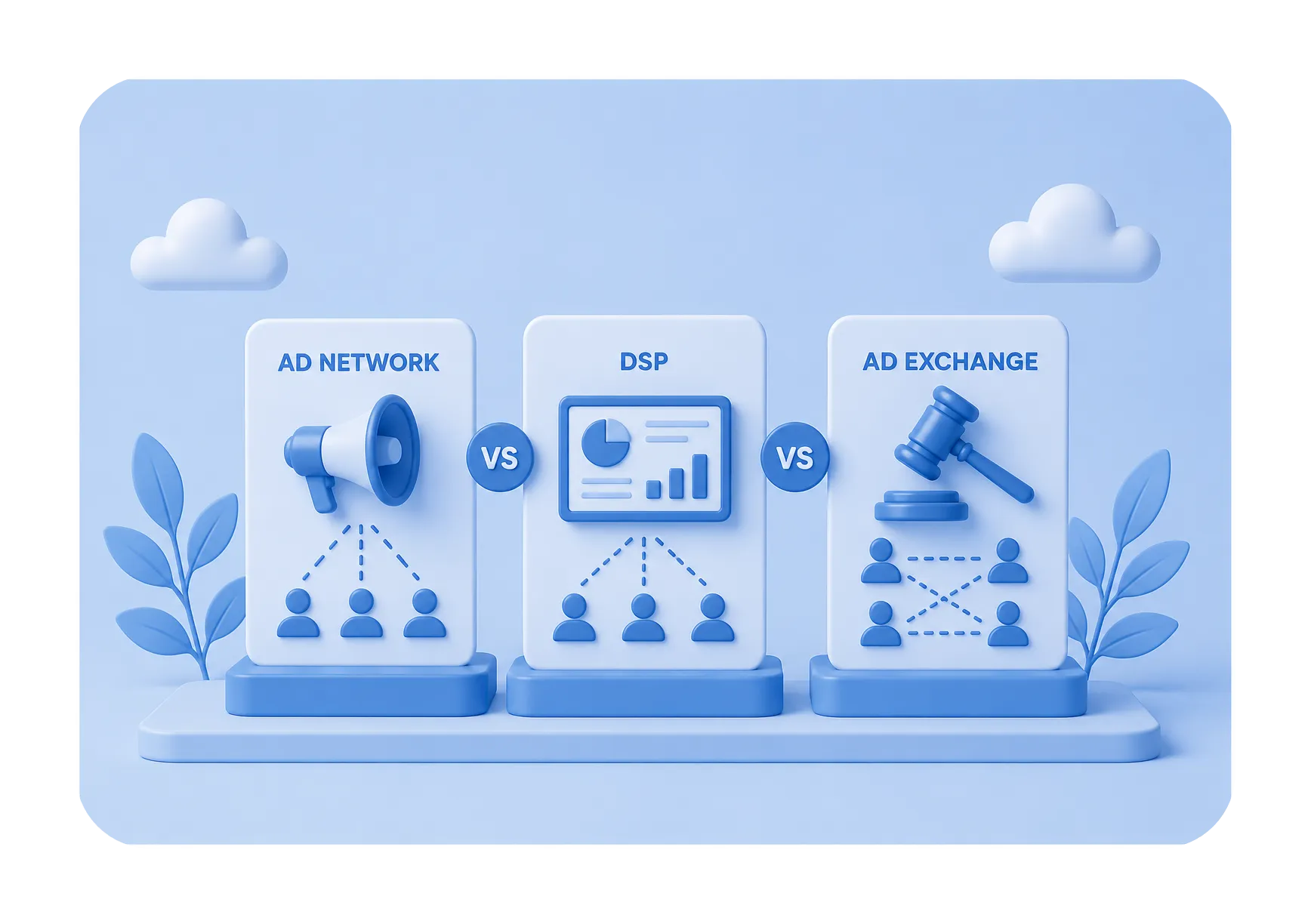
If you’re new to digital advertising, these three terms probably blur together. Ad network. DSP. Ad exchange. They all deal with buying and selling ads, so it’s easy to mix them up.
But they’re not the same thing. Each one plays a different role. And once you get the roles straight, the whole ad-buying world makes a lot more sense.
Let’s break it down, plain and simple.
What Is an Ad Network?
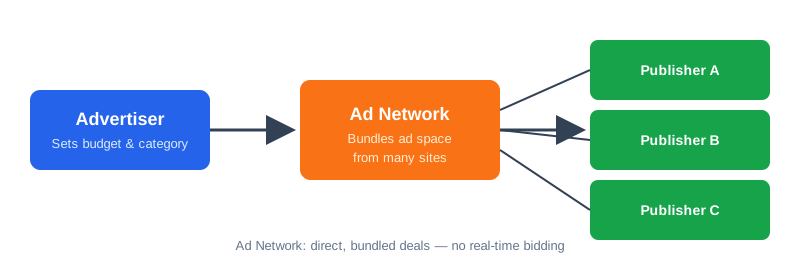
Think of an ad network like a middleman with a big contact list. It connects advertisers who want to run ads with publishers who have space to sell. Reacheffect is an ad network.
The network buys up ad space in bulk from lots of websites. Then it sells that space to advertisers, usually grouped by category or audience type.
Many modern advertising platforms offer direct access to publishers or automated buying tools, but ad networks remain one of the simplest ways to buy online ads at scale.
You don’t pick exact websites one by one. You just say “I want tech blog readers” and the network handles the rest. It’s simple, and that’s the whole point.
Ad networks were the go-to option before things got fancy. Google Display Network is a classic example. So is Media.net.
Good for: small advertisers who want an easy setup without a ton of tools or targeting options.
What Is a DSP?
DSP stands for demand-side platform. This one’s built for advertisers who want more control. Reacheffect is also a DSP !
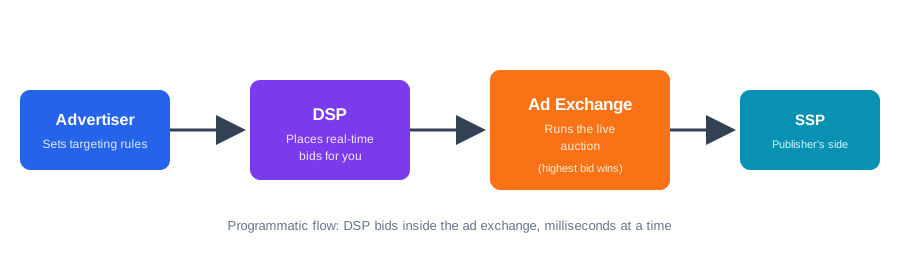
Instead of buying bulk space from a network, a DSP lets you bid on individual ad impressions in real time. This is called programmatic buying. It happens in milliseconds, every time a page loads.
With a DSP, you set your own rules. Target by age, location, device, interests, browsing behavior, whatever data you’ve got. Then the DSP automatically bids on ad spots that match.
It’s way more precise than a network. But it’s also more complex. You need to actually understand your audience and set things up right, or you’ll burn budget fast.
Good for: advertisers who want granular targeting and are willing to manage bids and budgets closely.
What Is an Ad Exchange?
Here’s where it gets interesting. An ad exchange is basically a marketplace. It’s where the actual buying and selling happens.
Publishers list their ad space on the exchange. DSPs (representing advertisers) show up and bid on that space in real time. Highest bidder usually wins the impression.
Think of it like a stock market, but for ad space instead of shares. Prices change instantly based on demand.
The exchange itself doesn’t buy or sell anything. It just runs the auction and connects everyone. Google Ad Exchange (now part of Google Ad Manager) and OpenX are well-known examples.
Good for: nobody buys “from” an exchange directly. It’s the infrastructure that makes programmatic buying work.
How They All Fit Together
Here’s the simplest way to picture it:
- Ad network = a middleman who bundles and sells ad space directly.
- DSP = your buying tool, where you set targeting and bids.
- Ad exchange = the marketplace where the DSP goes to actually place those bids.
In a typical programmatic setup, you use a DSP to define your campaign. The DSP then goes to ad exchanges to find and bid on matching impressions. The exchange connects to publishers (often through an SSP, or supply-side platform, on their end).
An ad network, on the other hand, skips a lot of this. It’s more direct. Less real-time bidding, more pre-packaged deals.
Quick Comparison Table
| Feature | Ad Network | DSP | Ad Exchange |
|---|---|---|---|
| What it is | Middleman selling bundled ad space | Buying tool for advertisers | Marketplace for real-time bidding |
| Who uses it | Advertisers, mostly small to mid-size | Advertisers wanting precise targeting | DSPs and SSPs, not advertisers directly |
| Buying method | Fixed deals, bulk space | Real-time bidding (RTB) | Hosts the real-time auctions |
| Control level | Low to medium | High | N/A (it’s infrastructure) |
| Setup difficulty | Easy | Moderate to hard | N/A (not used directly) |
| Example | Google Display Network | The Trade Desk | Google Ad Exchange |
Which One Should You Actually Use?
If you’re just starting out and don’t want to mess with bidding strategies, an ad network is the easier road. You set a budget, pick a category, and go.
If you’ve got a real budget and want to target specific audiences with precision, a DSP is the better tool. Just know there’s a learning curve.
You’ll probably never touch an ad exchange directly. It works quietly in the background, doing its job.
Most bigger advertisers actually use a mix. They might run some campaigns through a network for simplicity, and others through a DSP for tighter targeting. There’s no rule saying you have to pick just one.
A Few Things People Get Wrong
A lot of beginners think DSPs and ad exchanges are the same thing. They’re not. The DSP is your tool. The exchange is the marketplace the tool shops in.
Another common mix-up: thinking ad networks are “outdated” or bad. They’re not. They’re just simpler. For a lot of advertisers, simple is exactly what they need.
Last one: people assume you need a big budget to use programmatic buying through a DSP. Some platforms let you start pretty small these days, though you’ll get more value the more data you feed them.
Where Reacheffect Fits In
So where does a platform like Reacheffect land in all this?
Reacheffect is built as a DSP. That means you get real-time bidding, not fixed bulk deals. You set your targeting, by geo, carrier, OS, device, and the platform bids on matching impressions for you.
But it also acts like a network in the way it’s packaged. You don’t have to shop around for different ad exchanges or juggle multiple tools. Reacheffect connects you straight to a wide pool of publishers and exchanges through one login.
That’s actually a smart middle ground for a lot of advertisers. You get the precision of programmatic buying, without needing to build out a whole tech stack yourself.
A few things worth knowing about the platform:
- Ad formats: push notifications, pop-unders, native ads, in-page push, interstitials, and more.
- Targeting: real granular options, down to geo, carrier, OS, and device type.
- Reporting: real-time data, so you can see performance and budget as it happens, not a day later.
- Support: 24/7 campaign managers, plus a self-serve interface if you’d rather run things yourself.
If you’ve read this whole article and you’re thinking “okay, I want the DSP route, but I don’t want to spend weeks figuring out setup,” that’s basically the gap Reacheffect is built to fill. You get programmatic-level targeting through a system that’s built to be usable, not just powerful.
You can check out their advertiser platform here if you want to see it firsthand.
Final Thoughts
So, quick recap. An ad network bundles and sells space directly. A DSP is your bidding tool for real-time campaigns. An ad exchange is the marketplace where those bids actually happen.
None of these are “better” across the board. It just depends on what you’re trying to do, how much control you want, and how much time you’re willing to put into managing things.
Start simple if you’re new. Move to programmatic tools once you’ve got a feel for your audience and your numbers. That’s really all there is to it.