

The final whistle doesn’t end the World Cup betting story… It starts the second one. For sportsbooks, the tournament was about acquisition. For affiliates, what happens next is the real payday.
Here’s the number that matters: first-time depositors in LATAM hit 300% of pre-tournament baseline during the group stage alone. Europe hit 200%. The US hit 171%. Millions of brand-new bettors just opened accounts, and most of them have no idea where to go next. That’s the campaign.
The First-Time Depositor Surge, By Region
Optimove’s Group Stage Report, based on roughly 19 million active bettors tracked monthly from April through June 2026, found something operators don’t love to see but affiliates should love to hear: participation grew everywhere, but it grew fastest among people who had never deposited before.
LATAM led every region by a wide margin, hitting 300% of baseline. Europe followed at 200%. The US came in at 171%. Still a huge jump, just off a more mature starting point.

Read that as three different opportunities, not one campaign. LATAM is a volume play. Europe is a scaling play. The US is a value play. Fewer new users, but users who convert into higher-value long-term customers once they’re through the door.
Where Demand Spiked: The Geo Breakdown
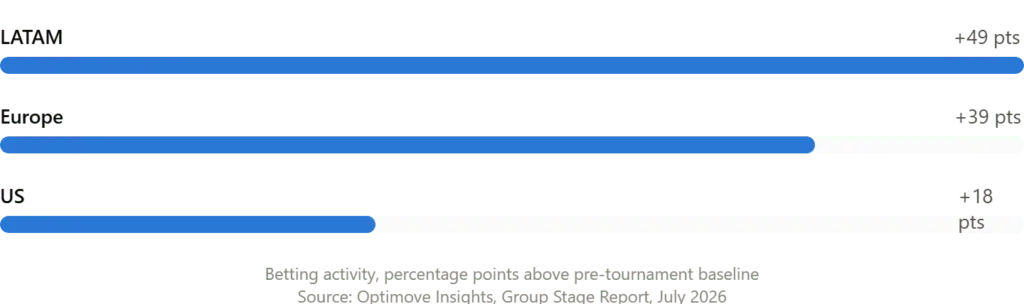
Depositor growth is one signal. Overall betting activity is another, and the regional split tells the same story from a different angle. LATAM betting activity ran 49 percentage points above baseline. Europe ran 39 points above. The US ran 18 points above.
The search data backs it up. Google confirmed that search volume broke all prior usage records during the Argentina vs. Egypt match. And the most telling detail isn’t the record itself, it’s what people were searching. After “schedule,” the top US World Cup query was “what is offside.”
That’s not a stat for the highlight reel. That’s your audience profile. This is a green, first-touch crowd that doesn’t know the sport, doesn’t know the odds, and definitely doesn’t know which sportsbook to trust. They need direction, and direction is exactly what affiliate content provides.
Who Spent the Money: The Brands That Dominated the Airwaves
Sportsbooks leaned hard on recognizable soccer names to build trust fast with a new audience. DraftKings ran Chicharito. FanDuel ran Landon Donovan. BetMGM built its push around Tim Howard, prioritizing CTV, online video, display, and paid social. Kalshi went a different direction entirely, fielding Marcelo, Di Maria, and Rio Ferdinand.

The number underneath all of it: an estimated 73% of sportsbook ad spend went to digital and performance channels. Not brand TV, not stadium boards, performance. That’s not a coincidence, and it’s not a trend affiliates need to chase. It’s already the model. This is validation from the biggest spenders in the vertical that programmatic and affiliate-driven acquisition is where the money works hardest.
Note: no third-party source has published a ranked, dollar-figure breakdown of who spent the most this tournament yet. If MediaRadar or Sensor Tower drops spend numbers next week, this section upgrades from “who showed up” to “who spent what.”
The Wildcard: Prediction Markets Ate a Piece of the Pie
Kalshi, Polymarket, and Robinhood combined for more than $50 billion in prediction market volume tied to the tournament. What makes that number worth a paragraph instead of a footnote: Kalshi specifically pulled in female and first-time bettors who had never touched a traditional sportsbook app. That’s a brand-new competitor class, which means brand-new offer types for affiliates to test in Q3.
The Catch: Smaller Wagers, Casual Users, Real Churn Risk
Here’s the part most recap content won’t lead with, because it doesn’t flatter the operators. Average wager size dropped in every single region. In the US, it fell from $266 to $239. In Europe, from $99 to $83.
That’s not a bad-news stat. That’s the affiliate opportunity, stated plainly: millions of new users made one small, low-commitment bet and then went quiet. Up to 90% of US bettors this tournament were betting on a World Cup for the first time ever, against a projected $150 billion in global handle. This is a massive, cold, unretargeted audience — and cold audiences are exactly what performance and affiliate traffic exists to warm back up.
Optimove’s own read on this: a wider audience doesn’t automatically become a deeper audience. Operators now have to tell casual, event-driven players apart from customers with real long-term value. That sorting work is happening right now, in real time, and it’s happening through re-engagement traffic — which is where affiliates come in.
The Playbook: How to Ride the Aftermath
Three moves make sense in the next two to four weeks:
Retarget the fresh depositors. This audience just onboarded and hasn’t been claimed by anyone yet. Push/popunder re-engagement campaigns aimed at recent-signup segments will outperform cold traffic by a wide margin right now, simply because the intent is still warm.
Go cold-geo, CPM or CPC first. LATAM’s 300% depositor surge is still underpriced relative to its size. Entry-level CPM and CPC buys in LATAM markets right now are cheaper than they’ll be once operators finish crunching their own post-tournament numbers and reallocate budget.
Send the traffic somewhere built for it. A 56-site sports publisher network isn’t a nice-to-have here, it’s the actual infrastructure this moment calls for. New bettors who searched “what is offside” two weeks ago need content that explains odds, bankroll basics, and how to read a sportsbook promo. It’s not a landing page that assumes they already know the vertical. That’s what turns a $239 average first bet into a repeat depositor.
Where Reacheffect Fits Into This
This is exactly the traffic environment Reacheffect was built for. A 56-site sports publisher network means the inventory to run entry-level CPM and CPC buys across LATAM, Europe, and the US simultaneously, There’s no waiting on one site’s capacity to catch up to demand.
The push and popunder infrastructure is already live and already tuned for iGaming, so re-engagement campaigns aimed at fresh depositors can go out this week, not after a month of setup.
And because the sites are built around sports content specifically, the traffic lands somewhere that already makes sense to a first-time bettor. Not a generic landing page, but the kind of odds-explainer, bankroll-basics content that turns a curious “what is offside” searcher into someone who understands what they’re betting on.
That’s the difference between chasing this audience and already being where they are.
The Window Is Now
Group stage data alone was enough to move this many new bettors through the door. Full-tournament numbers, landing within days of the final, will only make the case stronger. The operators are already deciding who’s worth retaining and who churns. The question is whether your campaigns are positioned to catch the ones they let go.