




Retargeting is more than just showing “another ad” to someone who has clicked before or visited your website. It’s about showing relevant ads to people who have a clear interest in your product or service.
But how do you know whether your ad is relevant?
And how do you know whether the person is actually interested?
One of the best answers to both questions is behavioral marketing. That’s why in this guide, we’ll explain how behavioral marketing improves retargeting by helping you build better affiliate funnels and get quality traffic.
What Behavioral Marketing Means in Retargeting
Behavioral marketing can take many forms. But when it comes to retargeting, it essentially means learning from users’ behavior to understand:
- At what stage of the funnel each person is,
- What ad copy is more likely to work,
- Who’s showing low intent and interest in your offering,
- And who’s actually worth retargeting, as they’re more likely to convert.
By tracking buying behavior, your retargeting ads strategy gains a huge advantage. Because you can see the traffic quality through users’ actions. Let’s imagine two scenarios to understand how it works. Say:
- User A clicks your ad and bounces right away.
- User B clicks your ad, spends over a minute reading your landing page, checks other pages on your website, and drops off at the signup form/checkout.
It’s clear that you should prioritize user B with your retargeting campaigns. But you wouldn’t know that if you didn’t have any behavioral marketing strategy in the first place.
On top of this, you can understand what moves the needle for prospects at each funnel stage. For example, for that user B, you might try creatives focused on social proof and special offers, and check which works better.
Why Basic Retargeting Is Not Enough
If we’re being completely honest, basic retargeting can bring results. And they can be decent.
But you can’t build a truly effective retargeting campaign or affiliate funnel without understanding what to say, when to say it, how to say it, and who should see it. That’s exactly why the results of basic retargeting can’t compare with behavior-based campaigns.
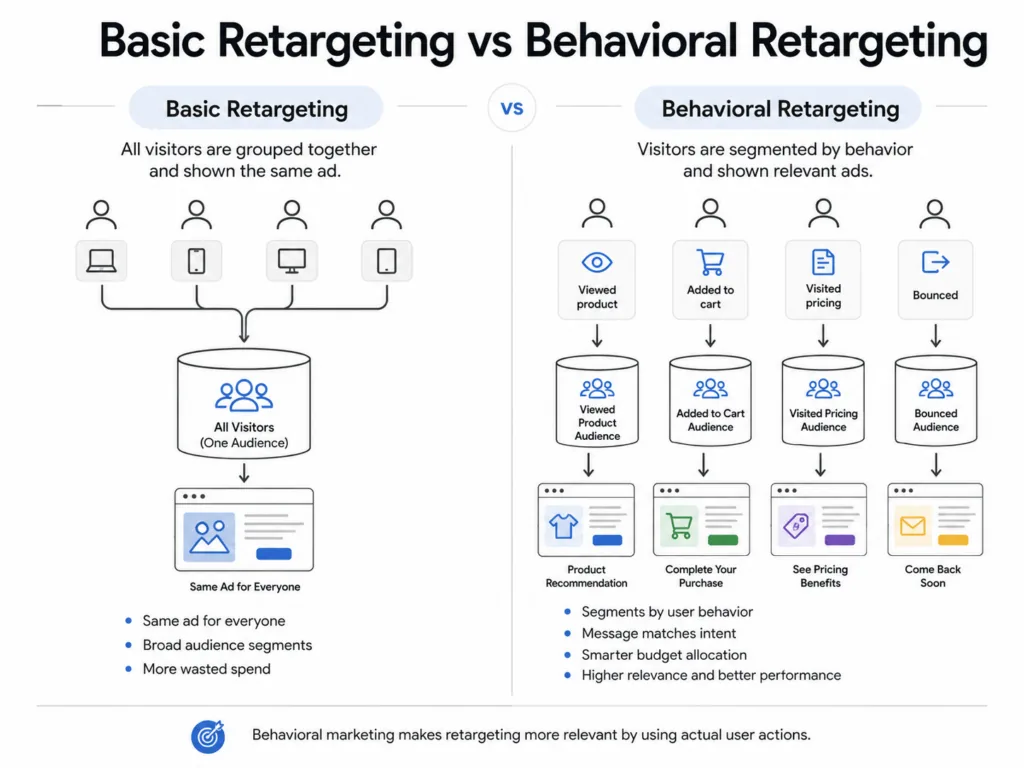
Even if you use the best paid traffic sources and the most effective advertising platforms for your niche, you still have to understand the person behind each click. And behavioral targeting helps you clearly see:
- Which users are more likely to convert,
- Which segments don’t deserve a big budget,
- Where many people drop off,
- What messaging works best for each segment or funnel stage,
- What traffic sources have lots of clicks but low conversions, and so on.
As a result, you can effectively target each segment and every stage simply because you understand how users behave.
How Behavioral Marketing Actually Influences Retargeting Performance
Now, let’s see exactly how tracking buying behavior helps improve retargeting campaign performance.
1. Improve Traffic Quality
There are several ad campaign optimization tactics. And they’re all important and effective. But often, even after fixing creative and optimizing bidding, many performance marketers still feel like they aren’t using the full potential of their campaigns.
Usually, the solution to this is improving traffic quality. In fact, it should be one of the main concerns of anyone who wants their ads to convert better.
You see, your campaign can get many clicks. But if most of those users don’t trust the offer or simply bounce without converting, you lose money for nothing.
But by tracking behavior, you can understand your traffic quality much better by:
- Seeing the real user intent behind each click,
- Finding clicks that have low conversion potential,
- Identifying more effective traffic sources,
- Improving audience segmentation, and so on.
Still, here is an important detail: some marketers assume that purchase history or last clicks are enough for effective retargeting. But it isn’t the most effective approach. Ideally, you want to look at the broader behavioral patterns.
A study of 25,402 journeys on a major travel platform found an interesting result. When they combined multiple behavioral signals (current journey search details, past journeys, and similar users with similar searches), the CTR improved by up to 28% compared to the last-click ad.
This suggests that it’s much more effective to use several behavior signals than to rely on a single data point (in this study, last click and most popular product).
2. Strengthen Affiliate Funnels
You can show the same ad over and over again and hope it works. But this will most likely feel generic and repetitive. So instead, you can align your ad copy with the actual stage of the funnel each user is at.
Behavioral marketing essentially helps you with these two things:
- Understand where people typically drop off: You can find out that a particular landing page is underperforming because it isn’t aligned with the ad. Similarly, many people could bounce while filling in the form because it’s too long.
- What creative/messaging matches each funnel stage better: This is a true goldmine, and the results can be quite unexpected. But the more you test different angles for your ad copy, the more interesting discoveries you can make.
This is how behavioral marketing can help you strengthen your affiliate funnel in the long run. Because once you understand how people interact with each type of content they see, you can make informed changes.
3. Protect Campaign Credibility
Retargeting can be spammy. If you simply show your ads again and again to audiences that aren’t even interested, it wastes your budget and can hurt your credibility. This often happens when the ads are generic, and the segments are too broad. But you can solve both of these issues by using behavioral data. It will help you know when:
- Adding a little nudge will help a user convert,
- Pushing BoFu content is useless because that person barely knows your brand,
- Aggressively promoting a product won’t help because some people don’t care anymore.
But there is also the other side of the coin: behavioral targeting can feel creepy if you overdo it.
One thing is showing an ad with a UGC testing video, user reviews, or a reminder that you’ll refund 100% of the money if someone doesn’t like your service. But the other thing is adding way too many personal details, making a person feel like they’re being watched.
The latter approach, in fact, can be counterproductive. The researchers found that when targeting is too narrow, people might feel “a threat to their freedom of choice.” As a result, they do the exact opposite of the ad’s intention. So, personalized marketing is great, but it shouldn’t feel too much.
4. Keep Your Message Aligned
You can write successful ad creatives only when you understand your customer. It’s obvious. What’s not so obvious is that every behavior signals a particular need. And a proper behavioral marketing strategy can help you find those needs and address them in your creative.
When you add personalized messaging, users feel heard and understood. That’s why your ads get actually noticed and make people move down the funnel and eventually convert.
One of the easiest ways to start improving your messaging is by aligning different ads with a specific funnel stage. Of course, it isn’t a linear process, and each conversion journey will be different. But even a simple traditional funnel can help you structure your testing better. For example:
- ToFu: When users are at the top of the funnel, it doesn’t mean they don’t “deserve” retargeting. What it means is that they need to understand your offer better, not get pressured into buying.
- MoFu: This is a consideration stage where users tend to look into more details, thinking about what brand/product/service to choose. Here, it’d be especially useful to track their behavior and check where they drop off. Because their doubts can vary a lot.
- BoFu: These are users who are closest to conversion. Often, they’ll show a very high-intent behavior (cart abandonment, dropping off the sign-up flow, etc.). Your goal is to understand what the last trigger is that can move them towards the purchase.
How do you know the exact behavioral triggers that work for each segment? Lots of testing. Maybe it’s not the answer you were looking for. But in reality, the more you test your assumptions, the more data you’ll have. And that data is what helps you make your retargeting more accurate.
5. Improve Budget Allocation
Not every user deserves the same bid. We all know that. But how do you know who deserves what? One of the ways to learn it is by using behavioral marketing.
Essentially, it helps you analyze the effectiveness and the true potential of each segment, channel, creative, landing page, and so on. By knowing this, you can build a more effective strategy that will help you optimize your spend. For example, you could:
- Scale channels and creatives that bring you more high-value conversions.
- Reduce bids for segments that consistently show low engagement and/or conversions.
- Exclude users who have converted or products/services they have already bought.
- Retarget those who already converted with relevant upsells or cross-sells, etc.
6. Make Testing More Effective
With all the behavioral marketing examples we’ve already seen throughout this article, you’ve probably realized that testing is one of the best use cases here. Basically, when you have behavioral context, you can better test what works for each segment.
You can do this as you see fit for your particular situation. But generally speaking, one of the most effective approaches is to test everything by segments. If you haven’t segmented your audience by buying behavior yet, it’s your sign to do that. And if you’re all set, use your segments to test different behavioral triggers.
Your goal isn’t just to create personalized messaging. It’s to understand consumer psychology. So, for example, you might find that:
- High-intent users don’t really need any discounts to buy because some additional testimonials are as effective.
- Users who aren’t likely to buy right away might really appreciate some UGC-like storytelling more than some tips and tricks.
- Mobile and desktop users (or users from different geographies) react to different creatives.
You can test nearly anything you can come up with. The idea is to get as much data on customer decision-making as you can. It will be extremely useful when testing new sources, creatives, segments, etc., in the future.
It All Starts With High-Quality Traffic
Even though we’ve been praising behavioral marketing, it can’t make up for poor-quality traffic.
Sure, it can help you create better segments, find strong behavioral triggers, write personalized messaging, and optimize your budget. But if your traffic is irrelevant, you won’t get nearly as many conversions as you hope for.
That’s why getting high-quality traffic is a must. If you don’t know where to start, explore Reacheffect. It’s a self-serve ad network built for performance marketers and affiliates. Here, you can test multiple formats within one platform, including Pop, Push, Native, Banner, In-Page Push, In-Stream Video, Interstitials, etc.
With ReachEffect, you can access a broad global audience, with a combination of 1.2B+ daily impressions and coverage in 195+ GEOs. And when you blend this with behavioral data, your campaigns can reach a whole new level.