
Media buying simply cannot be done by pressing “boost post” and wishing for a miracle! It is a really complicated and intelligent activity which brings together data science and audience psychology. It is carried out on platforms that make billions of tiny decisions every day.
Reality Check: I’ve seen advertisers spending $50,000 to find out what experienced media buyers can understand without even thinking. With this guide, you will learn only the most important things.
Media Buying in a Nutshell: Not Just the Textbook Explanation
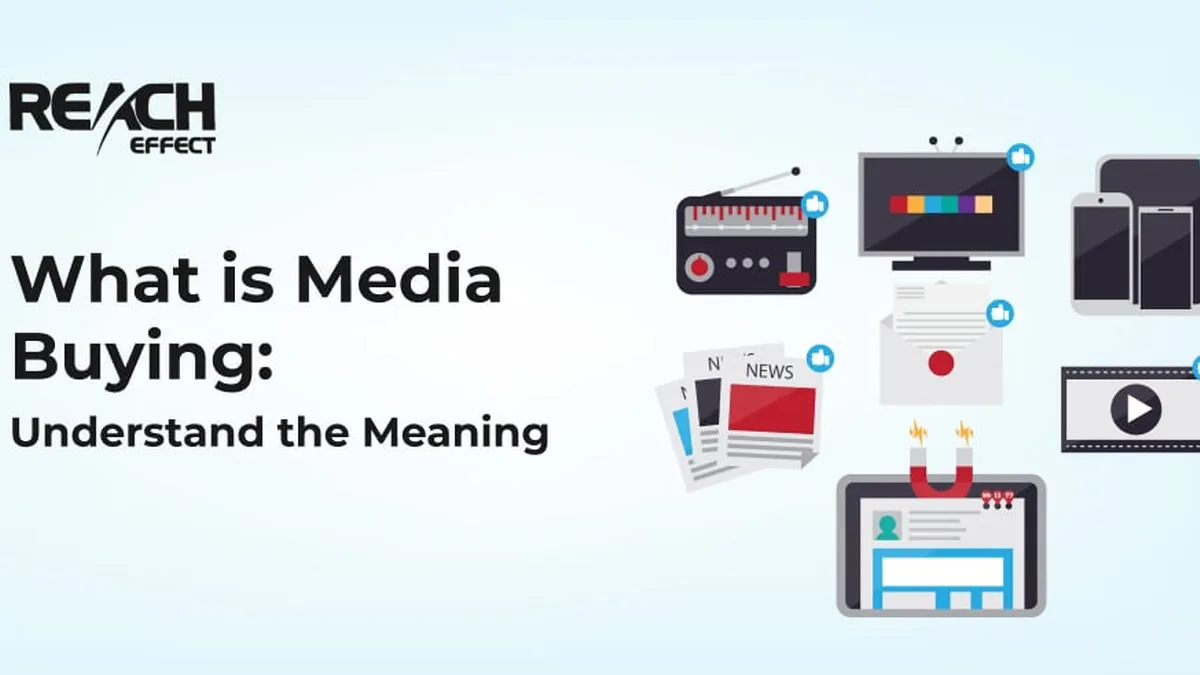
Media buying is a strategic system for acquisition. You are not only buying ad spots. You are creating traffic paths through the algorithmic networks that link your message to very likely conversion audiences.
In fact, the way it works: Today’s platforms gather the inventory from more than 10,000 publishers. Your campaign settings are what causes real-time bidding auctions that complete in 120 milliseconds. Professional buyers use this system to beat their competitors who are even willing to pay three times more for the exact same traffic.
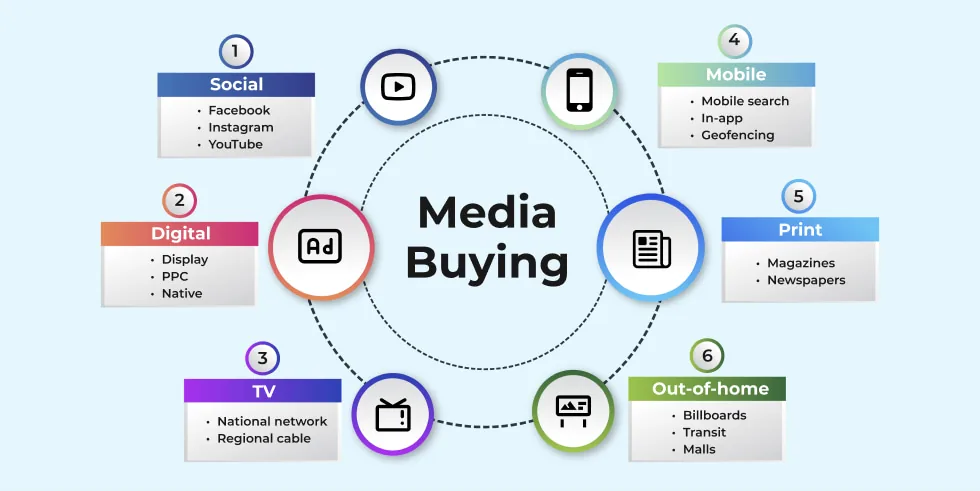
The Three-Layer Framework:
- Inventory Access: Publisher direct, programmatic exchanges, private marketplaces
- Audience Targeting: Using behavioral data, demographic filters, and contextual placement
- Optimization Systems: Using algorithmic bid adjustment, creative rotation, and conversion attribution
The Evolution: From Mad Men to Machine Learning
Not so long ago traditional media buying was just dialing radio stations and getting rates for newspapers. The digital transformation has changed the whole scenario.
What Changed in the Last 5 Years:
- Programmatic platforms today dominate 85% of digital ad inventory
- AI-driven optimization has taken over from manual campaign management
- Cross-device attribution is able to track users through 7+ touchpoints before conversion
- Real-time data feeds allow campaign changes to be made in less than an hour
Why This Matters: When I ran a campaign in 2020, it took 14 days just to collect the performance data that was significantly meaningful. Today, with the same campaign set-up, I get actionable insights in 6 hours.
Media Buying’s Role in Marketing Infrastructure
Strategic media placement is what decides your marketing’s visibility or disappearance into digital clutter.
The Hard Truth: In fact, a competitor with a second-rate product but excellent media buying can outsell your superior product placed ineptly. I’ve witnessed this pattern repeating in 40+ industries.
The Traffic Architecture Components:
Audience Segmentation Systems use machine learning to analyze behavioral clusters. These engines analyze browsing history, purchase patterns, content engagement, and demographic data to develop probability models. A fitness app marketing “weight loss seekers” may recognize 12 different micro-audiences with conversion rates ranging from 0.8% to 4.3%.
Channel Selection Matrices help identify platforms with higher performance potential. Not every channel delivers equal results. Pop traffic converts exceptionally for iGaming offers. Push notifications are
the leading method for sweepstakes vertical. Native ads are most appropriate for content-driven products. Experienced buyers keep performance databases that indicate which channels deliver best results for specific offer types.
Budget Distribution Algorithms figure out the best spend allocation. In contrast to distributing budgets equally, proficient systems allocate weight to proven performers while leaving test budgets for new brings. Taking a $10,000 monthly budget as an example, $7,000 goes to validated channels, $2,000 is to scale tests, and $1,000 is to experimental placements.
The Technical Infrastructure Behind Modern Media Buying
Typical media buying is done using complex technology stacks, which are invisible to most advertisers.
Demand-Side Platforms (DSPs) like Reacheffect offer the acquisition interface. These platforms are able connect to multiple ad exchanges simultaneously, thus enabling access to millions of available ad impressions across thousands of websites and apps.
Data Management Platforms (DMPs) gather audience data and help marketing teams understand their customers better. These platforms can intake your own customer data (first-party), data you get through partner collaborations (second-party), and commercially available audience segments (third-party) to create detailed user profiles that allow for extremely targeted advertising.
Attribution Systems follow the process users take leading up to a conversion or purchase. Today, attribution can track users from one device to another, across different platforms and various touchpoints so that credit for the conversion can be given appropriately. This data is then used by optimization algorithms to improve targeting continuously.
Skills Media Buyers Must Have
A professional media buyer is a mix of an analyst and a creative problem solver.
The fundamentals:
Being Expert in Data Analysis
This is what makes a professional stand out from the crowd. For starters, you should be able to analyze attribution data chains, know what statistical significance is, spot performance trends, and turn numbers into business decisions. For example, after CTR drops by 15% and conversion rate increases by 22%, is that good or bad? Professionals media buyers can answer this question fast.
Knowing Platforms
It entails having technical know-how to a deep level. No two advertising platforms are exactly the same. Facebook’s algorithm favors posts that get comments, shares, and likes. Ads shown on Google must get high relevance scores. If you want to advertise on Pop networks, you should expect a large number of impressions. The focus of ads on Push platforms is only really good subscribers. Professional buyers keep their knowledge on these platforms up to date.
Being a Good Negotiator
It can help you get the best among what is available in the inventory and also the best prices. Besides strengthening buyer-publisher relationship, one can gain access to new inventory releases, get lowered prices, and avail custom targeting capabilities, which are otherwise not surface through standard interfaces.
Having a Grasp on Creative
Will let you open the door towards performance optimization. Media buyers who have a knack of identifying the traits of creatives that convert best can guide design teams effectively, resulting in an overall enhancement in campaign performance.
Typical Media Buying Mistakes (And How Not To Make Them)
A major share of inadequacies in campaigns failure is due to faulty implementation of simple errors.
Mistake #1: Not Enough Conversion Tracking If you don’t use tools like S2S Conversion Tracking by Reacheffect, then you are basically blind. Make sure that you implement pixel based tracking, UTM parameters and conversion attribution before you even spend a lot of money.
Mistake #2: Optimizing Too Early Your campaign will not provide enough data for algorithms to learn and improve. If your campaigns are getting optimized before they reach statistical significance (typically 100+ conversions), then they are optimizing to noise rather than genuine patterns.
Mistake #3: Miss Matching of Channel Marketing software with enterprise B2B through pop traffic is not likely to be a success. Align your offer complexity and price point to the appropriate channels.
Mistake #4: No Change in Creative Newness is a key factor in attracting attention and ad fatigue leads to decrease in performance. Make changes of creative assets in rotation. Keep a check on frequency metrics. Change of messaging should be done every 2-3 weeks.
Mistake #5: Disregarding Negative Signals If placement report shows that specific sites or apps are not performing, then exclude those immediately. Smart buyers maintain large exclusion lists that are continuously updated with new exclusions over time.
The Future of Media Buying: What’s Changing
Media buying is changing rapidly and here are some of the things that will be quite different in the next 2-3 years.
AI-Driven Campaign Management is expected to be responsible for more than 70% of the optimization tasks. Bid optimization already happens by machine learning in the platform. Other tasks performed by humans like creative generation, audience discovery, and budget allocation little to no input from humans next-generation systems will be able to do everything.
Privacy-First Targeting is the future of targeting without cookies. Apple’s ATT framework and Google’s Privacy Sandbox are the main reasons why the whole industry is going through adaptation. Contextual targeting and first-party data strategies become critical.
Cross-Platform Attribution at the same time gets even better. They are now able to identify users across CTV, mobile apps, websites, and physical retail to build complete conversion pathway maps.
Automated Creative Optimization is able to deal with thousands of creative variations at the same time. Also, dynamic creative platforms are capable of generating personalized ad variations for micro-audience segments automatically.
Making Media Buying Work for Your Business
Strategic media buying is not just another expense, it can turn to be your growth engine if executed properly.
The Integration Principle: Media buying is not a separate activity. It is linked with your offer quality, landing page optimization, sales process, and customer retention. Failures at any point lead to campaign failure.
Starting Smart: Start with a single channel that you can execute well. Get very good at the channel. Get profitable. Then scale up. The biggest waste I see is moving to so many platforms before mastering any of them.
The Reacheffect Advantage: While general platforms offer many capabilities, specialized platforms focus on performance traffic by providing you with infrastructure purpose-built for conversion optimization. If you care about ROI more than vanity metrics, then specialized networks usually outperform general platforms at 40-60% lower costs.
Media buying done right is not a matter of chance. It is the result of planned traffic acquisition. It is strategy meeting algorithms. It is data-driven decisions being carried out through platforms which, on a daily basis, process billions of micro-transactions.
Get a good grip on these basics and you will be able to beat 90% of the advertisers who still consider media buying as an afterthought.